



Itineraries
Common Mistakes to Avoid on Your First Long-Distance Train Trip in Europe
October 09, 2026
Your first long-distance train trip in Europe is usually a good story afterward. The trouble rarely comes from the trains themselves. European rail is fast, frequent and mostly punctual. What catches people out are the habits carried over from air travel: that you can arrive twenty minutes before departure, that a big suitcase will vanish into a hold, that a ticket is simply a ticket. On the railway, none of that is true. Below are the mistakes that trip up first-timers most often, and what to do instead.
Booking late, or booking the wrong kind of fare
Long-distance rail in Europe works on yield pricing. Advance fares on high-speed trains in Italy, France, Spain and Germany are released in limited batches and climb as departure approaches, so the difference between booking six weeks out and six days out can be substantial. If your dates are fixed, buy early. If they aren't, decide how much flexibility you actually need, because the cheapest fares are usually tied to one specific departure and are non-refundable or heavily restricted.
The second half of this mistake is buying a ticket without understanding what it includes. A few things worth checking before you pay:
- Reservations. On high-speed trains in France, Italy and Spain, a seat reservation is compulsory and normally included in the ticket. In Germany it is optional — you can board with a ticket alone and stand if the train is full. Passes such as Interrail or Eurail cover the journey but often still require a paid reservation on high-speed and night services.
- Operator. A ticket is valid on the company that sold it, on the route and train it names. It will not be accepted by a competitor running the same corridor.
- Station. Cities have several. Paris has seven main stations serving different directions; Milan has Centrale and Rogoredo; Rome has Termini and Tiburtina. Check the station name, not just the city, before you book a hotel.
- Border crossings. Some international routes require a change of train, or a change of platform at a border station, even when the timetable looks like one seamless service.
Arriving at the station as if you were catching a plane
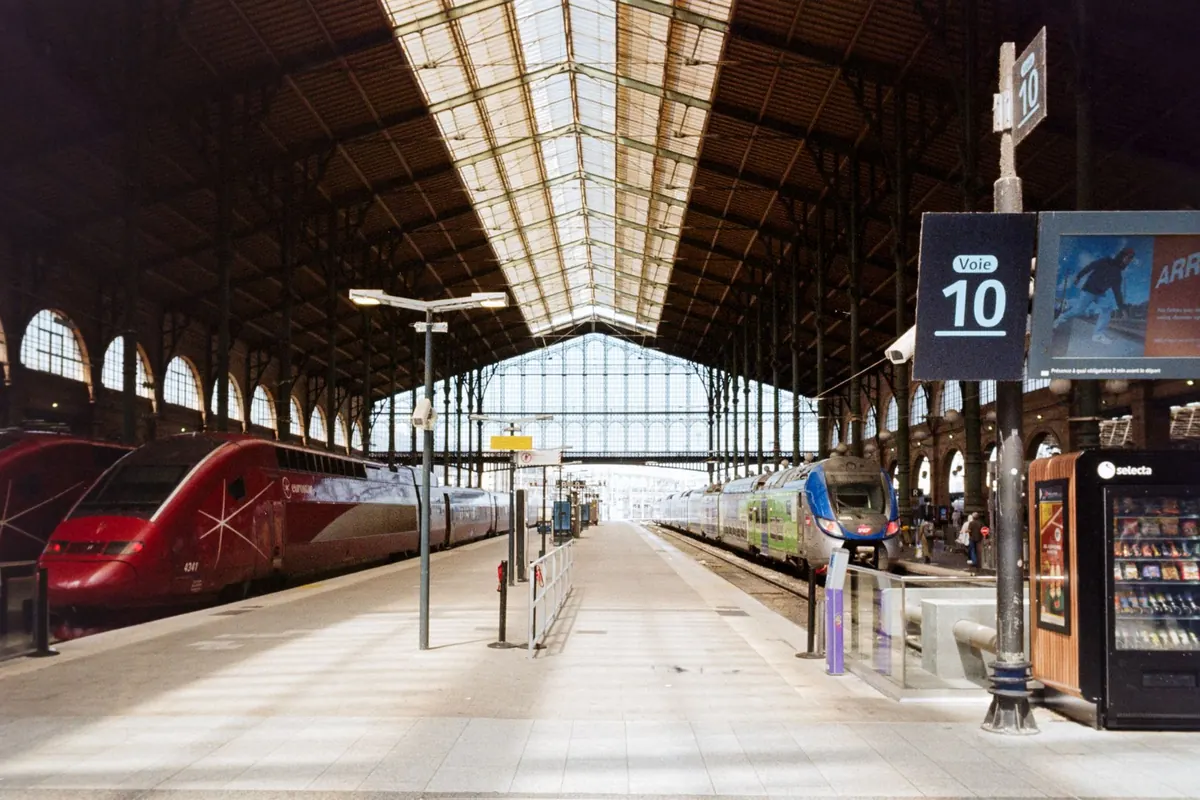
Fifteen minutes is fine in a small town. It is not fine at a major station you have never seen, where the walk from the metro to the right platform can take ten minutes on its own, and where your platform number may only appear on the departure board fifteen or twenty minutes before the train leaves.
Give yourself thirty to forty minutes at an unfamiliar city station, more if you are changing stations across town or travelling on an international service with ID checks. Some cross-border high-speed trains require passport inspection or a security scan before boarding, and those queues do not care about your connection.
Watch the board, not your phone
Platforms are reassigned at short notice more often than you would expect, especially late in the day. Stay within sight of the departure boards rather than settling onto a platform seat with headphones on. If your train is delayed, the board will tell you; if it moves, you will hear the announcement — but only if you are paying attention.
One detail that genuinely trips people up: in several countries, paper tickets bought from a machine for regional trains must be validated in a small stamping machine on the platform before boarding. An unstamped ticket can be treated as invalid by an inspector, and "I didn't know" is not a defence that tends to work.
Boarding the wrong train on the right platform
Two trains can share a platform from opposite ends, or arrive within minutes of each other. Read the train number and final destination on the carriage itself, not just the platform display. Platform markings also show where each coach stops — your reservation says coach 12, and the letters or numbers painted on the platform tell you where to stand so you are not dragging a suitcase down the length of the train.
Then there is the split train. On some routes, the front and rear portions separate partway through the journey and go to different destinations. If you are on the wrong half, you will end up somewhere perfectly pleasant and entirely wrong. Listen for announcements naming the front and rear destinations, and check the carriage displays.
Finally, doors close before departure, and they do not reopen for a latecomer jogging along the platform. Be at the door a couple of minutes early rather than sprinting at the scheduled time.
Treating luggage like a removal van
European long-distance trains are comfortable, but they were not designed around large hard-shell suitcases. Overhead shelves are shallow. The racks at the ends of carriages fill within minutes of departure, and boarding at an intermediate station means those racks are already full.
The workable rule is one bag you can lift above your head unaided, plus one smaller bag at your feet or on your lap. Beyond that, you spend the journey worrying about your luggage instead of looking out of the window.
A few habits worth adopting:
- Tag it inside and out. A card with your name and a contact number, plus a note of your destination train, has reunited a great many lost bags.
- Keep documents and valuables with you. Passport, tickets, cards, phone and any medication stay in the small bag you keep at your seat — not in the case in the rack six rows away.
- Do not block the aisle. If you are only going two stops, put the bag between your knees or in the space behind the last seat rather than heaving it into the overhead rack.
- Board early at the origin station. The first ten minutes of boarding decide whether you get rack space or spend the trip with a case on your lap.
Planning connections that only work on paper
Ten minutes sounds generous until you are changing at a large station, on a different level, with luggage and a platform change. Fifteen to twenty minutes is a sane minimum for a same-station connection at a major hub; give it longer if you have to cross the station, use a lift, or change stations in the same city.
Watch the last connection of the day. If your final leg leaves at 21:40 and the train before it is typically on time, that is still a plan built on nothing going wrong. Book the earlier option if you would rather not spend a night in an unplanned town.
There is also a ticket structure point that costs people money. If you buy two separate tickets to save a little, you have two separate contracts. Miss the second train because the first was late, and the operator of the second is generally under no obligation to help you. Buy a single through ticket for connections you actually care about — it usually gives you protection on the next available service if something goes wrong.
Forgetting the small things that decide the day
Nothing here is dramatic, but each one has ruined an afternoon for somebody. Carry water and something to eat on longer journeys; restaurant cars are not on every train, and queues can be long. Bring a European plug adapter and a power bank, because your ticket may live only on your phone. A charged phone with a screenshot of your reservation is worth more than a booking confirmation email you cannot open in a tunnel. Keep a little cash for smaller stations and cafés.
If you are travelling in a group, book seats together at the time of purchase rather than hoping to rearrange once aboard. If you have specific needs — a bike space, a wheelchair-accessible place, a quiet carriage — reserve those when you buy, not on the day.
A short checklist before you leave
- Confirm the departure station, the time and the train number from the operator's own confirmation.
- Check whether your ticket includes a reservation, and whether it is tied to that specific departure.
- Look up the platform and coach number the moment they appear, then check the carriage display before boarding.
- Aim to be on the platform ten minutes before departure, twenty minutes earlier than you think you need.
- Pack to a weight you can lift, tag your bag, and keep travel documents on your body.
- Screenshot everything: ticket, reservation, connection details, hotel address.
Do those six things and the trip becomes what it should be: a few quiet hours watching the countryside rearrange itself, with none of the low-grade panic that comes from not knowing which platform you are supposed to be on.
Photo: Bingqian Li / Pexels
Related posts
More stories you’ll love reading